Sebastian Böhler.
M.Sc. Computer Science, University of Tübingen · Founder, Sunderlabs
I build models, simulators and the software to test them. My work spans quantitative research, scientific machine learning and robot learning.
Quantitative research · Research engineering · Applied ML
Background
M.Sc. Computer ScienceUniversity of Tübingen · since 2025
Research AssistantHector Institute, Tübingen · since 2026
Founder, SunderlabsSimulation, robot learning and speech
Python · C++ · JAX · PyTorch
Selected results
2026QuantCo challenge
1st of 12 teams in the QuantCo challenge
Insurance pricing agents under a 60-second deadline.
START Hack League Munich
Agenthon
2nd of 63, Explainability track
Finance agents: explainability, forecasting, simulation and coding.
NeurIPS 2026 workshop
Learn2Design
13th of 110 in the final round
Gravitational-wave detector optimisation and a faster JAX simulator.
NeurIPS 2026 competition
EEG decoding
11th in the sealed final (provisional pending audit)
Cognitive-task decoding across sessions and participants.
NeurIPS 2026 workshop
Fusion equilibrium
11th, cross-machine generalisation
Physics-based plasma reconstruction on CPU; neural models for DIII-D.
NeurIPS 2026 competition
Research and competitions
Agenthon 2026
2nd of 63, Explainability track · 6th of 87 Forecasting · 6th of 55 Simulation · 17th of 61 Coding
Four tracks that test whether AI agents produce finance outputs that hold up under automated evaluation: coding, forecasting, simulation and explainability. In the explainability track, the agent predicts a label, value or ordering from a table and text evidence, and has to ground its reasons in exact quotes from that evidence. I took part with my team, Proof of Alpha.
Fusion Equilibrium Challenge
11th, cross-machine generalisation · 18th, DIII-D
The task is to reconstruct the magnetic equilibrium of a tokamak plasma from its diagnostics. For MAST no equilibrium labels were allowed, so instead of training a model I solved the free-boundary Grad–Shafranov equation for each of the 1,205 test shots, on CPU, from measured coil currents, the passive vessel structure and Thomson-scattering temperature profiles. For DIII-D I used an ensemble of residual MLPs.
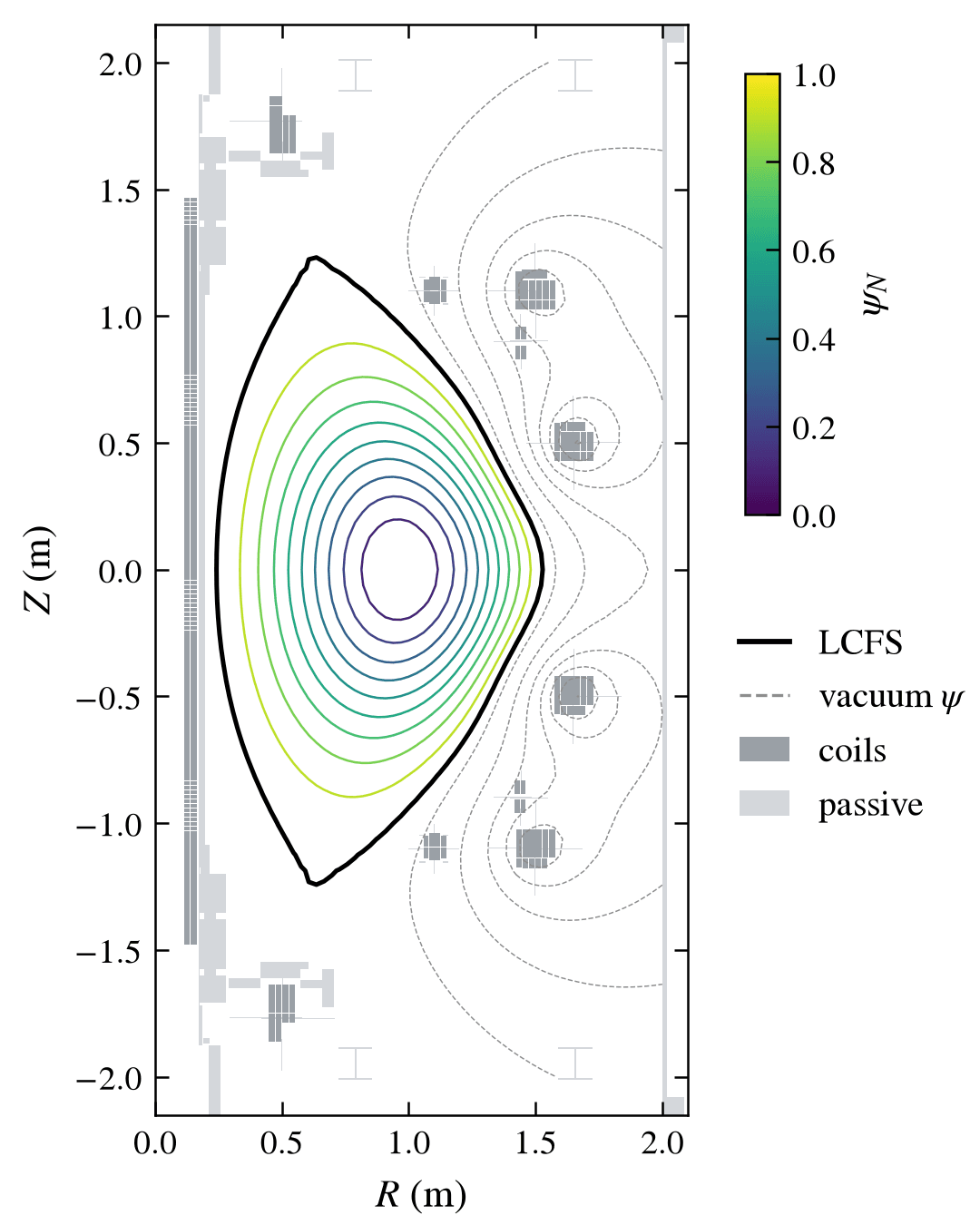
Predicted equilibrium for an anonymised MAST test shot. Black: last closed flux surface; coloured: normalised flux; dashed: vacuum flux. Learn2Design 2026
13th of 110 in the final round
Optimizers that design gravitational-wave detector interferometers in a differentiable simulator. I worked in JAX and built differometor-fast, a faster backend for the simulator. I submitted a technical report on 29 October; winners are announced on 11 December. A follow-up paper is in progress.
EEG/EMG Foundation Challenge 2026, Track 2
11th in the sealed final (provisional pending audit) · 84.4% cell-mean balanced accuracy
The decoder classified motor imagery, mental subtraction and word generation from four-second EEG windows. It combined an ensemble with label-free adaptation within each session and used participant-specific models when it recognized a returning participant.
QuantCo’s Claim to Fame
1st of 12 teams in the QuantCo challenge
With Tim Kiebler, Leo Driesch and Mattis Krauch, I built an agent that priced simulated insurance claims against a 60-second deadline. A persistent Claude Code session submitted a first quote in a median of 13 seconds and a refined quote in 21 seconds across its 83 rounds. A separate agent reviewed settled rounds and fed back what it learned.
Publication
QLoRA Fine-Tuning for Next User Turn Prediction and Multi-Step Dialogue Rollouts
Compute
EuroHPC AI Factory compute: two awards of 5,000 GPU-hours each on Leonardo (CINECA), one for the speech agent below and one for follow-up research on Learn2Design.
Projects
Learned flight control
Small learned policies for the Crazyflie nano-quadcopter. The policy proposes bounded velocity setpoints, while the onboard estimator and safety layer stay in charge. Simulation so far; first hardware flights are next.
German full-duplex voice agent
A voice agent that listens and speaks at the same time, handles interruptions and can use tools, in German. It runs on a EuroHPC AI Factory compute award on Leonardo BOOSTER. Early-stage research.
HB Capital
Market-structure tooling, backtesting and reinforcement-learning environments for trading research. Since 2023.
LecturePilot
A tutor for university lectures that works from the course's own material. Prototype.
Writing
Background
Experience
- Research Assistant, Hector Research Institute of Education Sciences and Psychology, Tübingen
- Founder, Sunderlabs
- Co-founder, HB Capital
- Backend Developer, LI.FI
- Full-Stack Developer, Remotly
- Freelance Full-Stack Developer, Boehler IT Solutions
Education
- M.Sc. Computer Science, University of Tübingen
- B.Sc. Computer Science, IU International University of Applied Sciences
Contact
Email is the best way to reach me: contact@sebastian-boehler.com. I'm interested in research internships and roles, including quantitative research.